
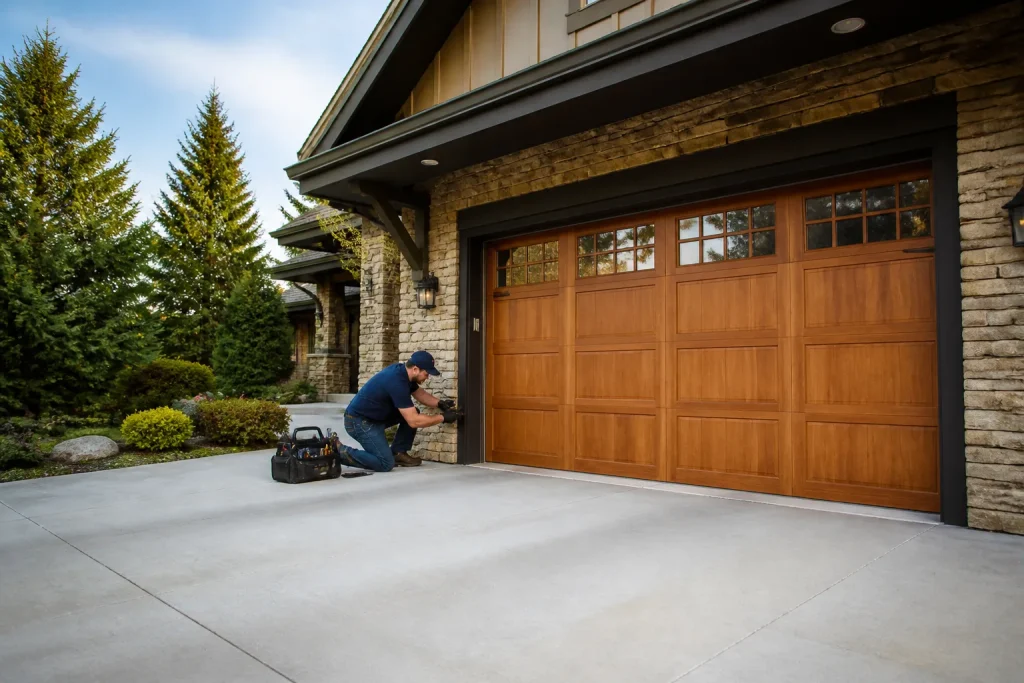
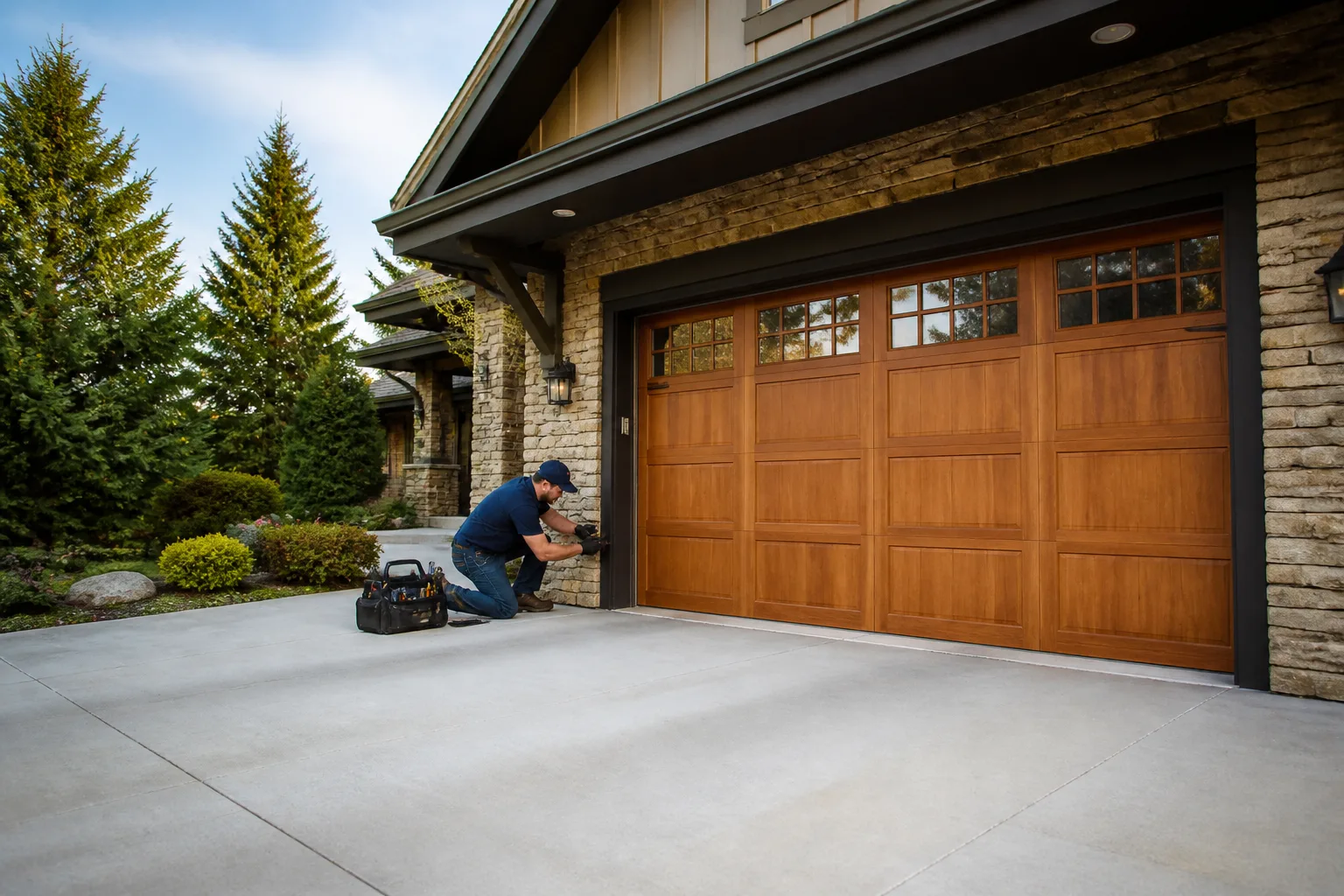
Chamberlain Garage Door Repair in Meadow Hills: A Homeowner’s Guide
Most Chamberlain problems announce themselves in a language nobody reads: the blink code. The opener’s logic board is trying to tell you whether it’s a sensor alignment, a travel limit drift, or a failing gear kit, and the answer is usually a ten-minute fix rather than a new unit. Before you price a replacement, learn the five failure modes this platform actually produces. And if you’d rather not DIY, call (855) 337-1334.
What are the most common Chamberlain failure modes in Meadow Hills?
Chamberlain openers fail in predictable patterns, which is good news. Five symptoms account for the vast majority of service calls we run across Meadow Hills, and each points to a different part of the system:
- Won’t open at all. Usually a dead safety sensor, a stripped drive gear, or a logic board that isn’t sending power to the motor. Listen for the motor hum: if the motor runs but the door doesn’t move, the gear kit is the suspect. If there’s no sound at all, start at the board and the outlet.
- Opens partially, then stops. A travel limit switch that has drifted or a door that’s binding on one track. The opener is doing its job; the resistance is the problem.
- Reverses immediately after touching the floor. Force sensitivity set too high, or a sensor misalignment that the board reads as an obstruction. Sometimes it’s a door that’s out of balance and genuinely needs more force than the opener is allowed to give.
- Remote works but the wall button doesn’t (or the reverse). This isolates the fault fast. Wall button working while remotes fail points to the remote, its battery, or the learn button memory. Remote working while the wall button fails points to the wall console wiring or the console itself.
- MyQ connectivity loss. The opener runs fine but the app shows offline. Nine times out of ten this is a Wi-Fi band issue or a router change, not a hardware failure.
That last one trips up a lot of Meadow Hills homeowners because it looks like a broken opener when the door is mechanically perfect.
How do you read Chamberlain LED diagnostic blink codes?
Chamberlain’s LED codes are printed in the manual almost nobody keeps, but a handful are genuinely useful without a support call. The light is on the back or underside of the motor head, and the pattern tells you where to look.
- Rapid blinking (usually 5 flashes, repeating). Safety sensor problem. Check that both sensors have power (LEDs lit on each), that the lenses are clean, and that nothing – a broom, a recycling bin, a kid’s scooter – is breaking the beam.
- Slower, steady blink patterns. These usually map to a travel limit or force setting the board considers out of range. Some generations blink a distinct count for a logic fault.
- No light at all. Power issue. Confirm the outlet, then the board.
Here’s the honest caveat: Chamberlain has changed blink behavior across model generations, so a code that means one thing on a fifteen-year-old unit can mean something else on a MyQ-era opener. The manual for your specific model number is the only reliable decoder. If you can’t find the manual, the model number is usually on a label under the motor head, and it tells a technician instantly which platform they’re working on. Bring us that number and we can usually tell you what you’re dealing with before anyone touches the door.
Which Chamberlain repairs can you safely do yourself?
Some fixes are genuinely homeowner territory. Others are not, and the split matters for your safety more than your wallet. Here’s where the line sits.
Safe to handle yourself
- Safety sensor alignment. Loosen the wing nut, aim the sensor until the LED goes solid, tighten. This solves a large share of “door won’t close” calls.
- Travel limit adjustment. The up and down limits are screw adjusters on the side of the motor head. Small turns, test between each.
- Force settings. Similar adjusters. Raise or lower in small increments only.
- Remote and keypad programming. Follow the learn-button procedure for your model.
Call a technician
- Logic board replacement. Board work means the opener is live while you’re inside it.
- Gear kit replacement. The gears sit inside the housing, and the door has to be disconnected and secured first.
- Motor capacitor. Capacitors hold a charge. This is not a homeowner job.
One safety note before anything else: never touch the torsion springs, cables, or bottom brackets above the door. Those hold the door’s full weight under extreme tension and can cause serious injury. A trained professional handles that side of the system. Opener electronics are a different risk but a real one – unplug the unit before any interior work.
Why does MyQ keep dropping in Meadow Hills?
MyQ disconnects are usually a Wi-Fi problem, not an opener problem. Chamberlain’s MyQ hardware connects on the 2.4 GHz band, and that detail explains most of the frustration homeowners in Meadow Hills run into.
If your router broadcasts a single combined network name for both 2.4 and 5 GHz, the opener can struggle to stay joined. Splitting the bands into separate names, or giving the 2.4 GHz network its own SSID, fixes a lot of it. Second: router replacements. A new router means the opener is looking for a network name that no longer exists, and it won’t reconnect without going through setup again. Third: signal distance. A garage on the far side of the house from the router, with a few walls in between, will drop. A mesh node or a simple extender closer to the garage often settles it.
If MyQ still won’t hold after a router check and a fresh setup, then it’s worth having the Wi-Fi module looked at. A quick call to (855) 337-1334 can sort out whether it’s your network or the unit before you spend anything.
What should a full Chamberlain repair visit include?
A proper visit covers more than the symptom you called about. If a technician swaps a gear kit and leaves, you’ve paid for a repair but not a service. Here’s what a complete visit looks like, so you can check it off when someone’s in your garage.
- The named repair, done and tested. Whatever you called about, run the door through three full cycles before the tech packs up.
- Safety sensor test. Both sensors aligned, LEDs solid, and a physical obstruction test – break the beam with the door closing and confirm it reverses.
- Force calibration. The opener’s force setting checked against the door’s actual weight and balance, not left where the last person set it.
- Travel limit check. The door fully closes to the floor without slamming and fully opens without straining the rail.
- Balance test. Door disconnected and lifted halfway – it should hold. If it drops or rises on its own, the springs need attention.
That last item is the one most often skipped, and it’s the one that explains why an opener keeps failing after a repair. If the door is out of balance, the opener is working against it every cycle. We handle full garage door repair alongside opener work, which means the door and the operator get checked together rather than one at a time. We also work on Raynor and LiftMaster systems, so if your garage has a mix of equipment, it’s all one visit.
When should you call a pro instead of troubleshooting?
Call when the symptom points inside the motor housing, when the door itself is out of balance, or when you’ve adjusted the limits and force and the door still misbehaves. Also call if the door is heavy to lift by hand – that’s a spring problem wearing out your opener prematurely. And call for anything involving the torsion system, full stop. Our technicians have up to 10 years of experience on Chamberlain and the other major platforms, and diagnosis is where most of the value sits: knowing what’s wrong before anything gets replaced. For full replacements and new units, we handle garage door opener repair and garage door installation across Meadow Hills, with the written estimate setting the price before any work starts.
The Bottom Line
Chamberlain failures are usually sensibly diagnosable: sensor alignment, travel limits, force settings, and MyQ network drops account for most of them, and those are fixes, not replacements. Blink codes, your model number, and a quick isolation test (remote vs. wall button) will get you most of the way to the answer. The repairs that need a technician – logic board, gear kit, capacitor, anything in the torsion system – are the ones where the risk isn’t worth the savings.
If you’re in Meadow Hills and need help, Garage Door Repair Meadow Hills offers free estimates. Call (855) 337-1334. We answer 24/7, with fast dispatch from 7am to 7pm, Sunday through Friday.
Frequently Asked Questions
Most Chamberlain opener repairs run in the range of a routine service call rather than a replacement, and the exact figure depends on the part – a sensor or travel limit adjustment costs far less than a logic board or gear kit. We quote the price in writing before any work starts, so you know the total up front. Call (855) 337-1334 for a free estimate.
Most Chamberlain failures are repairable. Gear kits, logic boards, sensors, and travel limits are all serviceable parts, and a unit that’s ten or fifteen years old is often worth fixing rather than replacing. Replacement makes sense when the motor itself is failing or parts for that generation are no longer made.
Rapid repeating flashes usually mean a safety sensor problem – check alignment, lenses, and obstructions first. Slower patterns generally point to travel or force settings, and some models blink a count that indicates a logic fault. The manual for your exact model number is the reliable decoder, since codes vary by generation.
MyQ hardware runs on the 2.4 GHz band, so a combined 2.4/5 GHz network name, a router replacement, or weak signal to the garage all cause dropouts. Splitting the bands or adding a mesh node near the garage usually fixes it. If it still won’t hold after a fresh setup, the Wi-Fi module may need a look. Call (855) 337-1334. We answer 24/7, with fast dispatch from 7am to 7pm, Sunday through Friday.
Written by the team at Garage Door Repair Meadow Hills.
Need Garage Door Help?
Call Garage Door Repair Meadow Hills - the local pro we connect you with is licensed and insured, here with fast help in Meadow Hills.
(855) 337-1334